
Introduction
This article provides an overview of what I believe is the correct usage of AI not only from a technical point of view but rather from a more psychological, ethical and human vision. This article is heavily influenced by Pope Leo XIV’s “Magnifica Humanitas” which I recommend reading.
Understanding AI for non-technical people
The first thing I want to do is to demystify how AI actually works so we can see it is not any type of black magic. If you are a technical person, you can safely skip this part as I will explain it in simple terms everyone can understand.
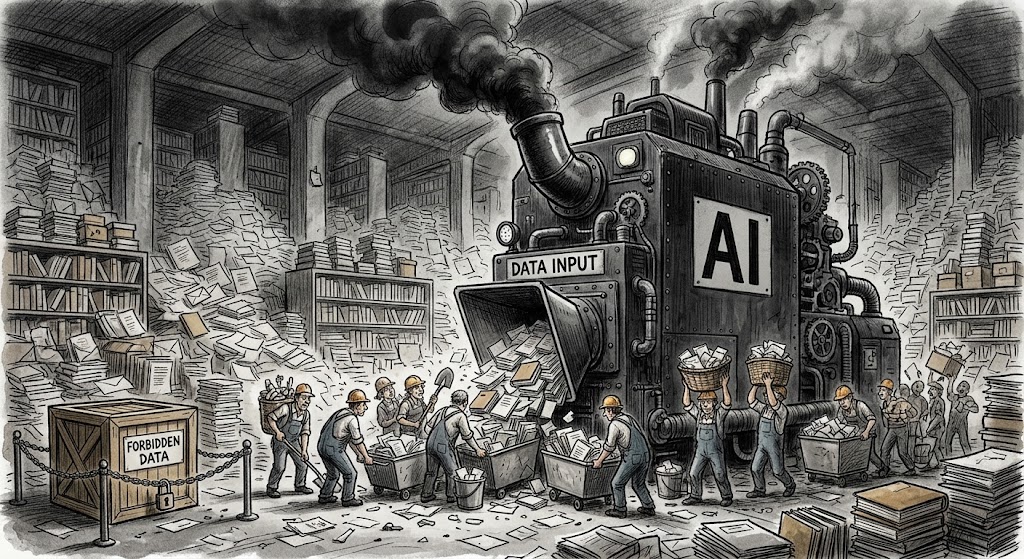
An AI is like a giant machine that contains lots and lots of information inside. Then when you interact with it, it replies with what is most statistically possible.
We can simplify “Most statistically possible” with “What makes the most sense based on the available information”. For example, when you say “Hello” to ChatGPT it will reply with another greeting because on all the data it has it is the most common thing to do. But do not let that fool you, there is no thinking or intelligence behind that.
Same thing happens when you ask it to generate an image, it will generate the image using the common patterns from the data it has. In fact if it only had pictures of Da Vinci in its data all of the generated images would look like Da Vinci paintings as that’s all it knows.
If we get a little deeper, It is just a massive mathematical formula which gets generated based on the data it gets provided. A crucial point here is that nobody understands the formula behind one of these AI’s because as the Holy Father points out it is “cultivated rather than built” 1. What that means is that the formula and specifically the values used make no sense to any humans as those values were generated by processing all of the data.
That is to say, an AI is nothing more than a machine in which we introduce as much data as we can, this can be for instance, the whole internet (millions of books, webs, etc…) and thanks to that data and to statistics an AI (the values of the math formula we were speaking about) capable of answering our questions gets generated.
Knowing this is crucial because it lets us draw two important conclusions. First, the AI doesn’t tell you the truth, it tells you what makes most sense from the data it has even if it is wrong or a lie. Second, see how I wrote In the data it has which means an AI can be easily manipulated if you only provided it with the data you want for your own interest.
Use a tool for a purpose
This is generic advice for any tool that is out there but is a useful idea to have in mind at all times. It is pretty clear that nobody would use a hammer to screw in a screw, this example is easy because we all understand what is the purpose of a hammer.
However with new technologies like AI and smartphones this is not the case as they promise to solve us many problems. First of all, technology is not the way for human salvation (but we will discuss that later). Second, this creates an environment where we are always searching for solutions into these tools, even when they can’t help us, or situations where we start doing one task with these tools but end up on a whole different thing.
The goal to avoid this is to have a clear goal in mind of what you want to do with it and once that is done stop using the tool. We computer people should be good at this as it is similar as writing requirements for software engineering or just writing a clear AI prompt, here are some examples:
- I will use AI to help me fix this bug (a concrete well defined bug)
- I will use AI to understand boolean operators
- I will use my phone to call X friend
If we define a clear task, once the task is done we stop using the tool until we need it again, this avoids distractions and ending up doing things that aren’t necessary. Even if it sounds easy I encourage you to try it since we are in a world where attention is one of the main currencies and the goal is for you to lose track of your goals.
If you still feel this is not enough and you keep getting distracted even when you have clear task in mind, my recommendation is that the main goal should be to not get distracted. That is to say, instead of the goal being producing something, the goal is keeping your attention. For example instead of thinking “I’m going to fix this bug” think “I’m going to devote an hour free of distractions to fix this bug” but putting all of the focus on not getting distracted without forcing yourself to complete the task in that period of time, the ultimate goal is to not get distracted. This has helped me greatly especially during remote work in which I easily get distracted.
What you use it for, you will forget
Another simple example to explain this point is: if you have been used to screw in a screw with your bare hands and now you start using a screwdriver you will eventually lose the finger strength to screw with your hands. Of course, situations where you just use your hands to screw are limited and a screwdriver is almost always the answer however, this also happens with any other skills.
I don’t think anybody is bothered by the fact that we have lost the skill to train carrier pigeons now that we have phones but an automation or advance doesn’t have to be always good especially when it becomes extreme like it is becoming now.
This is something to really think through, especially in the time of AI, more concrete examples are: Do you want to forget how to code? Do you want to forget how to write by yourself? Do you want to forget how to solve problems?. Maybe we can forget coding and delegate all of it on AI but if we take it too far, we are just losing the ability to think for ourselves and that includes telling right from wrong and many other human capabilities which makes us truly human.
On top of that delegating on an AI also creates a fake sensation of objectiveness as the AI will always reply will full confidence but as mentioned above that is just based on the data it has which can be wrong or purposely manipulated.
Letting AI choose
“A computer can never be held accountable, therefore a computer must never make a management decision” Is a phrase from a 1979 IBM presentation, they were truly ahead of its time. To me this means many things at different levels.
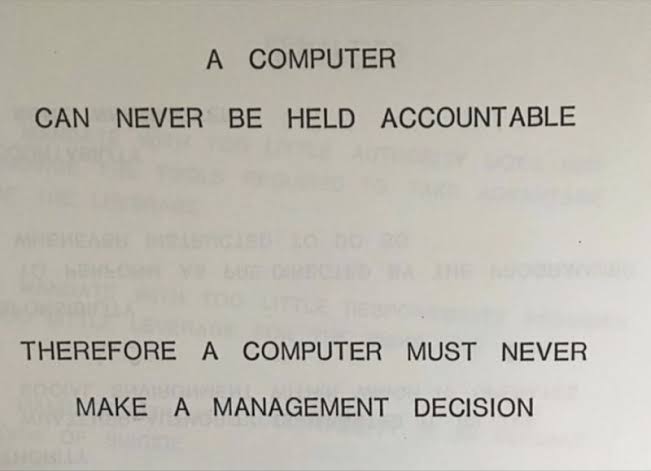
At a work level it means that even if AI does some part of the job I must be the one who takes the decisions of how a system is going to behave and what design it is going to have. It also implies having a clear trace on who did what as the AI is not to blame but rather the user or the creator of such tool.
It is not enough with what is technically called “alignment” which just means trying to make the AI understand human values (that is why some tech companies now hire philosophers). Because there is no consensus on which are those human values the only thing that is achieved is just imposing the moral values and biased of such company into their AI model. That is why we cannot consider AI morally neutral and should have no opinion on decisions.
Furthermore, many people use AI in their day to day life to aid it taking decisions which is fine but, if every time you have a problem you ask an AI what to do, are you truly choosing or is the AI choosing and you are just acting? In that case AI would be dominating your behavior. I think it is a good idea to think first for ourselves, design a solution and then if necessary (because you want to be extra sure or because it is something critical) ask the AI for any flaws in our idea. This can prove useful for technical task like cooking a complicated dish, doing some car maintenance by yourself, etc.
Even if your initial plan is a complete disaster because you have no experience in such field, you have trained your reasoning skill and the AI can help you to refine the plan after you have thought about it by yourself. Let’s remember that trial and error is one of the best and most effective ways of learning, we should not be looking to not make errors.
Of course, even better than asking the AI is asking another human being especially on topics related to human relationships or general life advice which leads us to the next section.
AI is not human, therefore is not your friend
This might sound obvious but we need to be careful with it. As mentioned AI simulates the behavior based on its data, that data is human data so the AI tries to act like a human (it is even reinforced to do so with alignment). This makes having a text based conversation with an AI similar to having a text conversation with a human but it is not the same thing.
It is a dangerous practice treating an AI like a human friend because on the long run it can create a fake bond that can slowly drag you out of society. This is especially true for people with a poor social and affective life as they can become addicted to this kind of simulation and in the end lose the drive to create real meaningful connections. I believe we need to be especially careful with this around children as if you are born now with this technology you might have a hard time telling the difference between AI or human if you are exposed to it at such a young age.
In general, I think this point is clear and almost everyone agrees that we need real human connections to be happy humans but, I feel like with time the idea of having AI friend or even AI partners will become more and more socially acceptable since we live on a time where in spite of having social media, data shows that people now feel lonelier than ever. This is quite alarming and something we should push back on.
Unfortunately, there are already many webpages and businesses now taking advantage of this and promoting AI friends or partners that you can even customize to your liking thus exploiting socially vulnerable people. It is not hard to find stories of people who have suffered greatly because of this 2 3.
Lastly, the fact that AI is not human does not give us the right to treat it with disrespect, it is true that from an anthropological view since it is not human or alive it does not have any real dignity. Then the point of treating it badly, insulting or being rude to it should pose no issue but I prefer not to do that. Even if you are interacting with a machine, being rude or having bad manners is a reflection of your inner self and you should in all situations avoid that kinds of behavior and be kind, even if it is just a machine.
Welcome to a Technocracy
The world is quickly evolving into a technocracy, this means that power is highly related with technology and therefore those who control and have knowledge over technology are the ones who have the most power. In most cases the people in charge of these high end technologies are not governments or people that look for the common good (in theory governments should do that) but private companies that have their own interest which in most cases is just getting more profit or winning over the competition.
With that last bit I don’t mean that companies or the people who run them are inherently evil, in most cases these people are just chasing their dreams but they fail to consider how their actions and aspirations impact in the rest of society (something we all do) because they are so blinded by their obsession they are unable to see it or even willing to make a sacrifice to make their vision come true.
Since companies are the ones controlling these AI models they decide what is good or bad for that specific model or how the model thinks and behaves. In an extreme example if there were an antisemitic AI company they could perfectly create a model that would align with their way of thinking and if lots of people used that model some of them would start believing what it said, let’s not forget the rule number one of propaganda “a lie told a thousand times becomes a truth”.
In fact this is already happening even if it is on accident. When you use ChatGPT, Claude, Gemini… they have a bias depending on the data they were provided with, in this case is mostly western cultural influence. Sadly, it is also pretty hard to tell which model is biased in which way directly without doing some reverse engineering as another problem of this technocracy is that they keep most of their information closed and private to win over the competition. As said before, this works for their goals but not for the greater good as I believe that for a just and fair scientific development all progress should be shared.
Technological Advances Do Not Equal Progress
In this context of a technocracy it seems like every technological advance means progress. Even us, when thinking about the word progress may think about robots, flying cars and other futuristic tech. However, the truth is that there can be technological progress but it doesn’t imply real progress.
I think we can all agree that from a high level of abstraction our goal in life is to be happy. Of course that sound really generic but it gives us a good definition of progress. We are progressing if in the end we are happier.
This does not mean that progress should always feel good, sometimes we need to suffer or go trough some tough moment to progress but in the end we end up happier (more on this later). Now, lets also not look just for our own happiness but lets look at it globally where everyone in general is happier.
That means that progress can be translated into things like:
- Improving human dignity
- Reducing poverty and inequalities
- Improving the distribution of goods
Because as humans we are social creatures and thus we need to advance together. This is proven by the fact that if just one group of people advances by themselves history tells us what ends up happening (corruption, slavery, abuses over the weak…).
As you can see then technological advances do not always bring progress. For example, the growing rates of mental health issues caused by our new way of living and partly by new technologies. Then, we need to see how these new things are really contributing to progress and to inequalities and not stop them but at least regulate them and treat them with care.
I would like you to think about the happiest moments of your life, I’m sure there is something in common in all of them, you were not alone. Then it seems clear that any technological advance that strips away human connection cannot be progress for a being like us that needs that connection. Unfortunately, AI and new technologies can lead us down that dehumanizing road.
Posthumanism
Very related are the currents of thought like posthumanism that believes that as humans we are flawed and we need to fix those flaws. But as mentioned earlier sometimes progress is painful and it is caused by some of these so called “flaws” but in the end thanks to this flaws we learn and end up being happier.
In general these currents of thought merged with the technocratic society view humans like resources that can be exploited, that serve a production purpose and in which their value and dignity depend on how efficient or useful they are.
But, it is by knowing our weaknesses, our internal wounds and our limitations we learn how to be more merciful and compassionate and that is also what makes us humans too.
Let me give you a simple example: Being in love. When you are in love with someone you are objectively speaking mentally weaker, you can get manipulated easier and it is harder to think straight. However, being in love also allows you to experience one of the greatest sensations in life, it gives you that drive to serve the other person with an open heart, to love them, to serve them.
But, that wouldn’t be possible if you were not in a weak spot it’s you being weak that allows you to love that way. There are countless examples of similar situations where our weakness becomes our strength in a way. Remember St. Paul already wrote “My grace is sufficient for thee: for power is made perfect in infirmity.” (2 Cor 12:9)
So, if we start considering everything that makes us weaker or fragile a flaw to fix we will end up getting rid of what it means to become truly human. I love how the Holy Father summarizes this “For an algorithm, an error is a flaw to be corrected; for a person, however, an error can be a catalyst for profound change. A person’s future is not calculable, but depends on one’s freedom” 4.
Anthropic and the Vatican
Before concluding, I would like to give a brief overview of the relationship between Anthropic (One of the biggest AI companies) and its relationship with the Holy See.
When the Encyclical letter was published, the Holy Father among other personalities gave a speech on the topic. The one that caught most of the attention is Chris Olah, billionaire, co-founder of Anthropic and lead engineer on the interpretability team. Chris is an atheist with an evangelical background 5.
Still in his speech 6 he shows great respect to the Holy See and asks for its help discerning the future path of AI. It is at least a good sign that we are open to such dialogue even if we do not agree. I especially liked Chris’s sincerity on this topic citing his words:
“Every frontier AI lab—including Anthropic—operates inside a set of incentives and constraints that can sometimes conflict with doing the right thing. The pressure to stay commercially viable and to stay at the research frontier. Geopolitical pressure. And the older, plainer pressures of pride and ambition. No matter how sincerely any of us intend to do the right thing—and I believe many of us do—we will always be influenced by those incentives.”
A proof of this is how the Holy Father calls for more sustainable datacenters while Anthropic has already promised to invest 50 billion dollars on AI infrastructure. On the other hand, Anthropic and the Holy Father do agree on being extremely careful with AI and war. This is proven by the fact of Anthropic refusing to collaborate with the US government to develop autonomous weapons. However, if Anthropic does not collaborate some other will, which is a real issue.
About the relationship between Anthropic and the Holy See, I agree with Paolo Carozza, a law professor at Notre Dame 7. He remains skeptical about this as the main brand of Anthropic is being “pro-safety” but this could just be a marketing strategy to present them in that way.
Another point to make is the Rome Call for AI Ethics which started during 2020 under the pontificate of Pope Francis and that aims to have AI follow a set of ethical principles. Companies like Microsoft, IBM or Qualcomm signed the agreement but Anthropic has not 8. Still this has no legal or regulatory binding effects.
Conclusion
In this article we have highlighted some of the dangers and questions posed by modern technologies. Our main goal as humans should be to keep being human, not to lose important skills such as critical thinking or even other more mundane skills. We must look for a world where dignity and equality are the main goal not a world where we look at other as tools or means of production basing their value on what they provide.
Then we are called to be careful with the technology we use and especially to understand how it can lead us to doing the wrong thing or to manipulate us. This doesn’t mean to be a Luddite but to be critical and somewhat knowledgeable of the tools we are using. Another of our goals as humans that has always been there is to search for the truth (which requires the skill of critical thinking).
Apart from looking at this technology from a general level which is a great exercise to get us close to the truth, everyone should ask themselves calmly if they are using these tools right and if they should change something about it. Statistically speaking most people should make a change, just by looking at the mean screen time of the general population. Try and be honest with yourself and see where you are lacking. Think if AI is truly helping you or if you are just not thinking anymore.
Once you have looked inside it is probably time to change, changing is not easy and that could be a whole other article but let me give you one final idea. If we want to make the world a better place we must start by changing our own customs, because customs are what silently move the world, just think of the slow changes of customs over the years. Change your customs and slowly but surely people around you will do it too, your children, your spouse, your friends, that is our little way to change the world.
Extra: Quick note on the term AI
The term AI is a really broad term. AI came before ChatGPT and has a more ample meaning. In general in this article we have focused on the AIs called LLMs (Large Language Models) like ChatGPT mostly leaving other kinds of AI without mention.
But, AI can also be the algorithm that finds the path from A to B (Google Maps), a computer playing chess (Deep Blue), an image classifier, etc. It is worth pointing this out to be precise and avoid misunderstandings. However, it is true that most of the media uses the term AI without taking this into account and that is also a big part of the reason I used it like that here too.
Disclaimer: No AI was used to write the contents of this post, this is fully original and my own personal opinion.
Google and Character.AI to Settle Lawsuit Over Teenager’s Death ↩︎
https://www.cbsnews.com/colorado/news/lawsuit-characterai-chatbot-colorado-suicide/ ↩︎
Anthropic co-founder Chris Olah’s remarks on Pope Leo XIV’s encyclical “Magnifica humanitas” ↩︎
Anthropic’s alliance with pope on AI harms: all in good faith or Vatican-washing? ↩︎